Introduction
Lucrezia Contini completed the Master 39 program at BigRock in 2025. In the months following the completion of the program, she worked on various projects, including those for her showreel. She chose to focus on a reel showcasing prop modeling and texturing, a field she has always found interesting and stimulating and which she continues to enjoy immensely.
The choice of project
After identifying his direction—in part thanks to the support of his mentor, Francesco Rosati—he planned the projects to include in his showreel, selecting a series of eye-catching objects to create. Among these, they agreed on modeling a vehicle, a type of prop that is particularly interesting due to the level of detail and precision required.
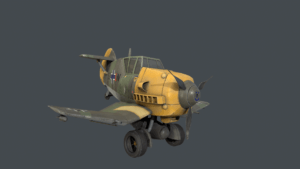
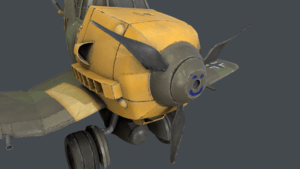
Despite an initial lack of interest in vehicles, Lucrezia decided to take on the challenge to step outside her comfort zone. The solution came when she adopted a more personal approach: creating a toy vehicle. While searching for reference material, she came across a model kit depicting a chibi-style version of a World War II Stuka, a discovery that immediately made the project more engaging.
Modeling
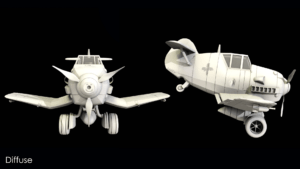
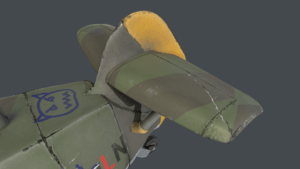
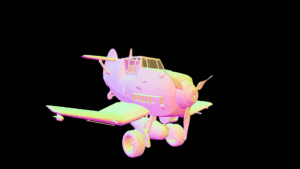
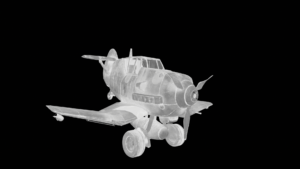
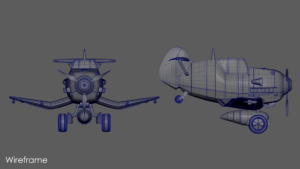
After analyzing the reference materials, Lucrezia began the modeling phase, which turned out to be more complex than expected. One of the most challenging aspects was studying the wings: she had initially underestimated their structure, failing to take into account that the profile is biconvex and symmetrical.
This involved numerous revisions of the mesh, with continuous adjustments until a satisfactory result was achieved.
UV and preparation
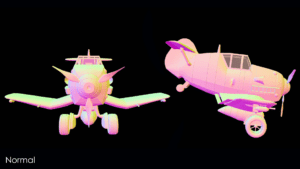
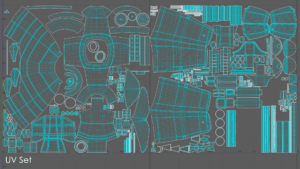
Once the modeling was complete, work continued with the UV mapping phase. This is a technical and often laborious step, but it is essential for ensuring that textures are applied correctly and that the final result looks realistic.
Texturing
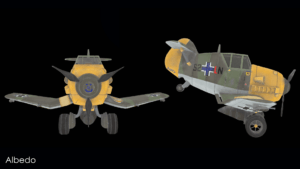
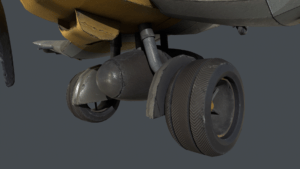
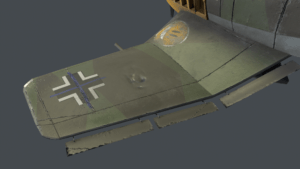
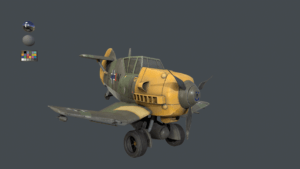
The texturing phase was guided by a clear vision: to transform the model into a well-worn toy. The goal was to tell a story through the details, adding scratches, dents, paper tape, marker drawings, and stickers.
Using Substance 3D Painter, Lucrezia began by defining base colors and materials, carefully studying the characteristics of plastic to achieve a realistic result. She then enhanced the model with progressive levels of detail: color variations caused by sun exposure, accumulations of dirt and dust, signs of wear, peeling effects, and manual graphic adjustments.
The final rendering
For the final stage, Lucrezia used Marmoset Toolbag, which she chose for its ease of use and versatility. She selected an HDRI that brought out the model’s colors and details while creating soft shadows.
To achieve more precise control over the lighting, he added two additional lights, thereby achieving the desired result and completing the project.
Conclusions
This project is a concrete example of technical and personal growth: taking on a challenge outside one’s comfort zone, turning it into something inspiring, and seeing it through with determination.
A journey that demonstrates how, even when starting from a field that initially seems far removed from one’s interests, it is possible to find a creative approach and achieve an effective and personal result.