From Observation to Understanding: Learning Perspective in the Field
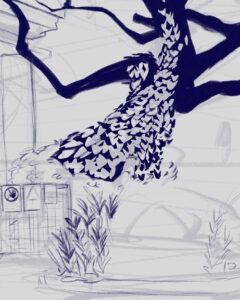
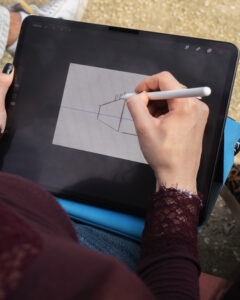
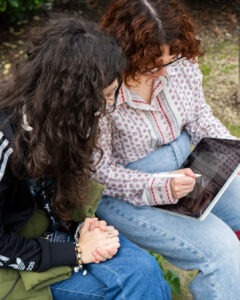
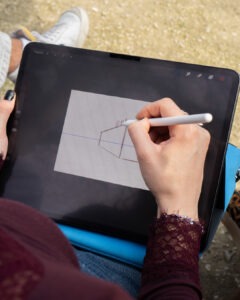
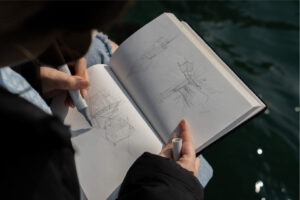
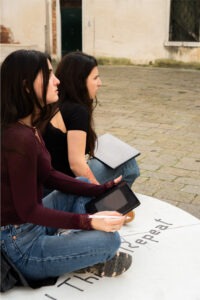
Last week, the art students left the classroom to work in Venice on a live drawing session. The goal was not just to draw, but to gain a practical understanding of one of the fundamental concepts of drawing: perspective.
Taking students out of the school setting means giving them the opportunity to observe the real world, engage with the complexity of their surroundings, and translate what they see into drawings on paper. In this way, what may seem theoretical in the classroom becomes a firsthand experience.
What Is Perspective (Really)?
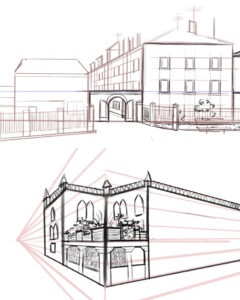
Perspective is a technique that allows us to represent a three-dimensional space on a two-dimensional surface. It is based on a very simple principle: what we see from a single viewpoint, as if we were observing the world with just one eye.
In the case of central perspective:
-
the lines of the observed object are perpendicular to the horizon (parallel and perpendicular)
-
The object is facing forward, without any tilt
-
All lines converge at a single vanishing point
It is precisely this system that creates the illusion of depth.
The vanishing point: the center of the space
One key aspect that the students were able to experience firsthand is the role of the vanishing point.
It doesn't necessarily have to be in the center of the drawing:
-
it can be lateral
-
may be out of frame
And yet, all paths will continue to lead to it.
In fact, perspective is not merely a technical construct; it is a tool that guides the viewer’s gaze, leading them through the depicted space.
Drawing from life: when theory meets practice
Drawing in Venice allowed the students to tackle real-world problems:
-
choose a perspective
-
identify the horizon
-
identify the directions of the lines
-
manage proportions and depth
Every mistake, every correction, every attempt has made it clearer how perspective works.
Tips based on experience
During the activity, several key practical principles emerged:
Adjusting the field of view
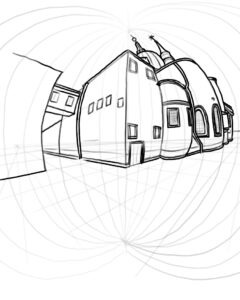
The closer the vanishing points on the horizon line are to each other, the wider the field of view appears.
The viewpoint determines the scale
. Lowering the viewpoint makes objects appear larger and more imposing.
The Circle in Perspective
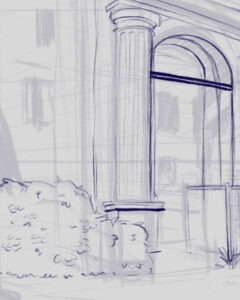
To draw a curve correctly, it is helpful to identify as many points as possible: the more points you find, the more precise the shape will be.
Diagonals as a measuring tool
Diagonals allow you to create evenly spaced segments and are an essential tool for establishing correct proportions.
Learning by doing
This experience confirms a key principle of our approach: what is learned in the classroom takes shape and meaning when it is put into practice.
Going out, observing, and sketching from life means turning abstract rules into practical tools. Above all, it means learning to see.
Because perspective, even before it is a technique, is a way of looking at the world.